Yesterday, in Part 1, I showed you what happened when I started looking at the people running a Facebook group I had recently been invited to join.
What looked like a perfectly ordinary Guam community group with nearly 28,000 members became a lot more interesting once I looked at the administrators, their profiles, and the other groups connected to them.
But I hadn’t even looked closely at what they were posting yet.
So that’s what I did next.
And this is where I want you to learn another trick:
Don’t just look at what a suspicious account posts. Look at what it’s asking other people to do.
Because once I started doing that, a pattern began to emerge.
“Say: I LOVE GUAM!”
One post from administrator Jenny Brown immediately caught my attention.
The image said, “We never hear from most of the 27k members of this group. So, if you are still with us, say: – I LOVE GUAM!”
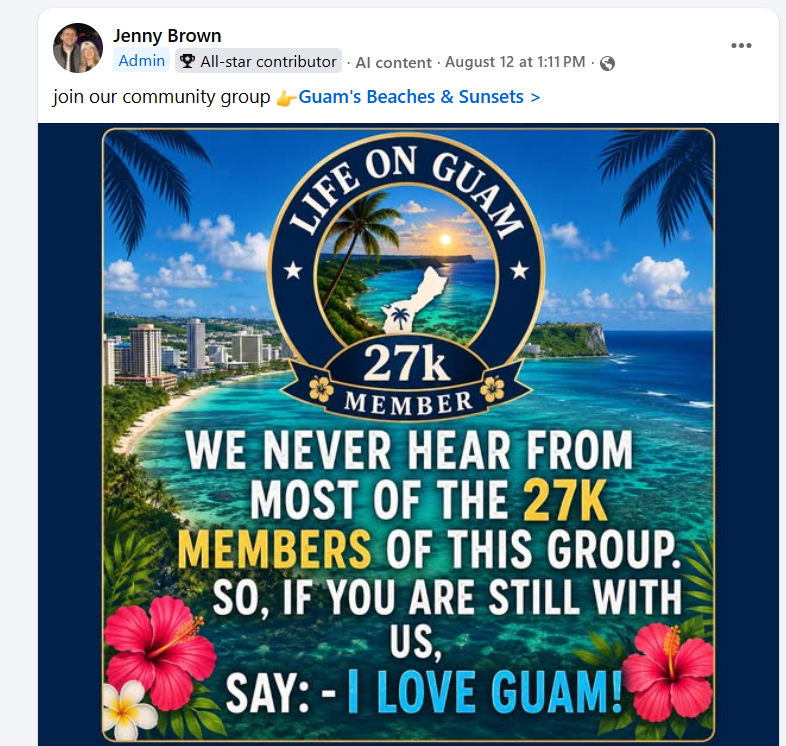
And right above it was another invitation to join Guam’s Beaches & Sunsets, the second Guam group we looked at in Part 1.
On its face, there’s nothing sinister about asking people to say they love Guam. I’ve probably said it a few thousand times myself.
But there’s a name for posts specifically designed to get people to like, comment, share or otherwise interact: engagement bait.
That’s not my terminology.
Meta describes engagement bait as posts that “goad” people into interacting with likes, shares, comments or other actions in an attempt to boost engagement and reach.
And this post wasn’t subtle about what it wanted.
27,000 people. Are you still here? Comment.
Why does that matter?
Because engagement has value on social media. A group filled with people actively commenting, sharing and responding can be far more valuable to someone trying to increase reach than a quiet group with thousands of passive members.
But then I found posts asking members for something more interesting than a comment.
“Share your Guam photos”
Administrator Jessica Jeli posted a call for photos:
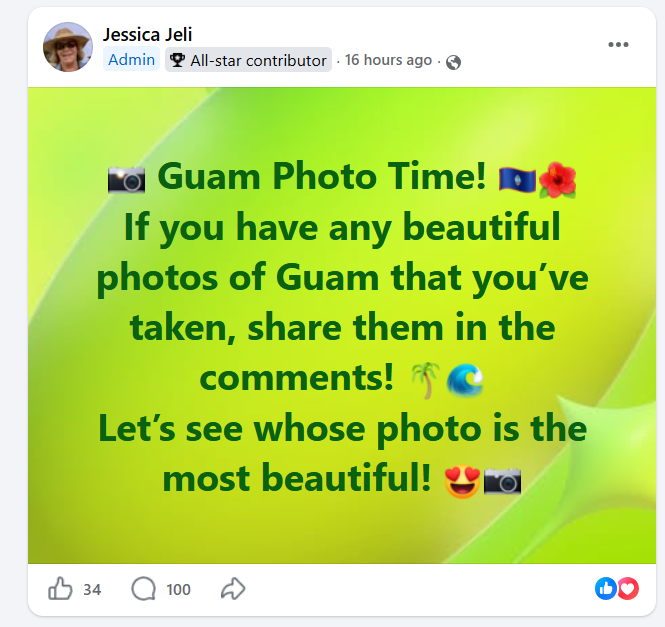
And people responded.
As you can see, the post had around 100 comments when I captured it.
Again, let’s be careful here.
People ask for photos in Facebook groups every day. A request for vacation photos is not evidence of a scam, and I cannot tell you why this particular administrator wanted members’ photographs.
But I can tell you what the request accomplishes.
Instead of the administrator having to find authentic photographs of Guam, members of the group are voluntarily supplying them.
Real sunsets. Real beaches. Real neighborhoods. Real landmarks. Real photographs taken by people who actually know Guam.
And that made me wonder.
What happens to those photos after someone puts them in the comments?
I’m not saying these administrators were collecting photographs for reuse. I have no evidence establishing that.
But I do know that photographs posted publicly online can be copied and reused.
I’ve had it happen to me.
A photo I took of one of my own T-shirts and posted in a Guam Facebook group was later taken and used elsewhere.
So when I see an account with questions already surrounding it asking thousands of people to contribute original, locally authentic photographs, I pay attention.
And so should you.
Then they asked for local knowledge
Another post from Jessica Jeli caught my attention for a different reason.
She posted an old-looking photograph and wrote, “Stationed on Guam in 1970. I don’t recall where this is.”
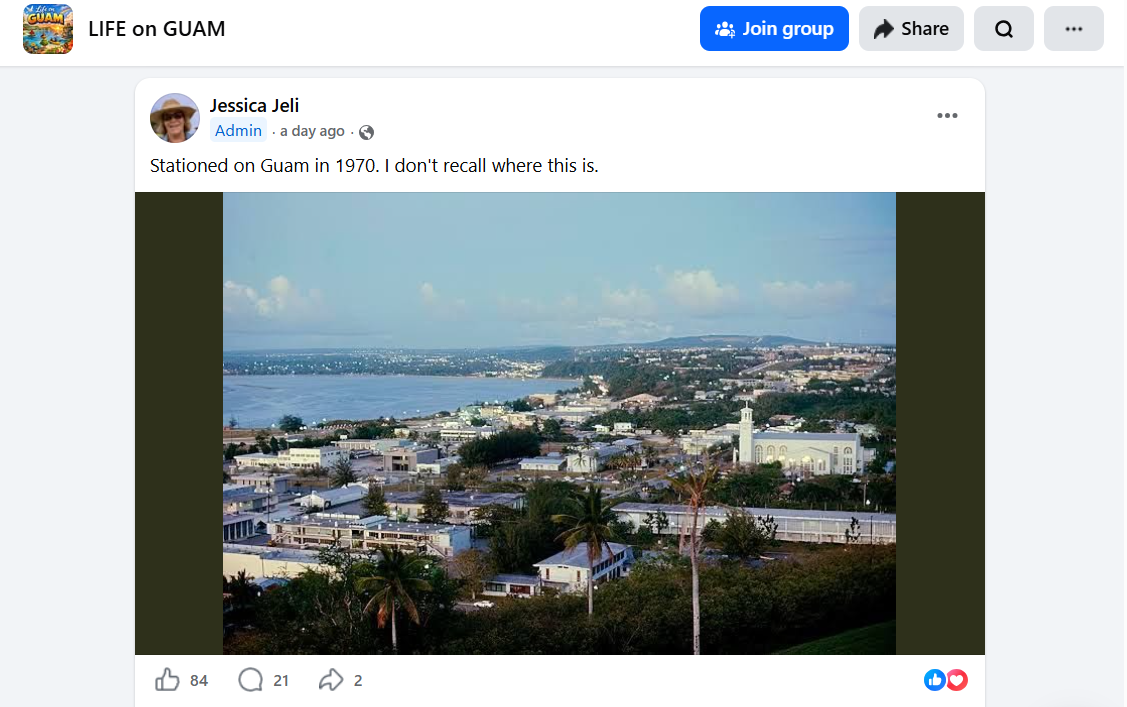
Then she let the group do what community groups do extremely well.
They supplied the local knowledge.
People who recognize a building, street, beach or neighborhood can identify it. People who lived there decades ago can add history. People can correct mistakes and fill in details that someone unfamiliar with the island might never know.
Again, I cannot tell you why that question was asked.
Maybe the person genuinely wanted to know.
Maybe it was simply another way to generate conversation.
But there’s another possibility worth understanding.
If someone wanted to make an account, group or future content sound more knowledgeable and authentic about a community, what better source of information could there be than thousands of people who actually lived there?
That’s not proof of what was happening here.
It’s a reason to ask another question.
Look at what the community is providing
This is where I stopped looking at these posts individually and started looking at them together.
Members were being encouraged to:
Comment.
Identify themselves as active members.
Share original photographs.
Identify locations.
Supply memories and local history.
Each request by itself is completely normal Facebook behavior.
It’s the pattern that interests me.
And there’s another wrinkle.
At least some of the content being posted to this community was labeled by Facebook as AI-generated.
Henry Jack, another administrator we met in Part 1, posted an “OLD GUAM VS NEW GUAM” collage comparing locations around the island. Facebook displayed an AI-content label on the post.
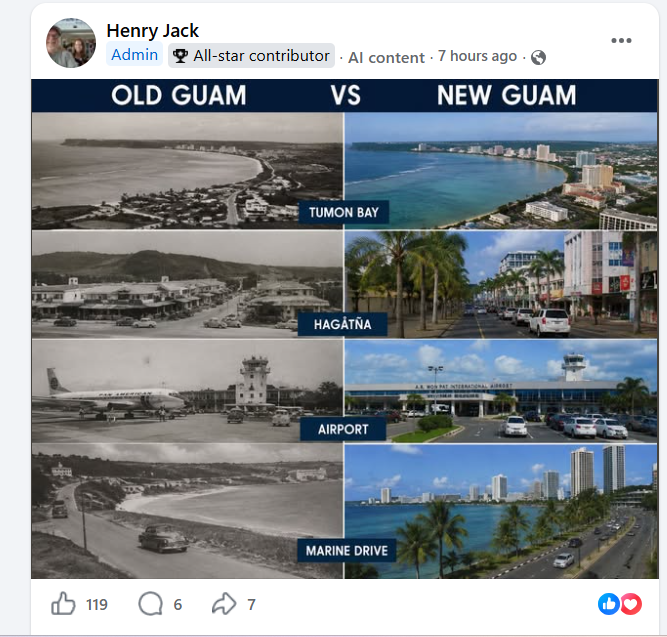
Jenny Brown’s “I LOVE GUAM” graphic was also labeled as AI content.
Think about that combination for a moment.
Some of the content going into the group is being labeled by Facebook as AI-generated.
Meanwhile, real people inside the group are supplying photographs, memories, locations, corrections and local knowledge.
That doesn’t prove anything nefarious.
But it does make the exchange worth noticing.
Here’s the lesson
When you’re trying to decide whether you trust a Facebook group, don’t limit your investigation to the administrators’ profiles.
Watch the behavior of the group itself.
Ask:
What are members repeatedly being encouraged to do?
What information are they being encouraged to provide?
Who is asking?
Does the person asking appear to have a genuine connection to the community?
Are the same accounts asking similar questions repeatedly?
Are members supplying information that makes the group or its administrators appear more authentic or knowledgeable?
You don’t need to know someone’s motive to recognize that information has value.
The FTC warns that scammers can use what people post on social media to figure out how to target them. And the scale of the problem is enormous: people reported $2.1 billion in losses from scams that began on social media in 2025, with more reported money lost to scams starting on Facebook than on any other social platform.
But I still had one question.
Why go through all this trouble?
Building groups. Maintaining profiles. Creating content. Generating engagement. Getting people to participate.
Engagement may have value, but was there something else going on here?
So I kept scrolling.
And then I found the merch.
That’s where we’ll pick this up in Part 3.
Want to know what I found? Subscribe so you don’t miss Part 3 when it’s published.
The Anatomy of a Suspected Facebook Group Scam
This is Part 2 of a four-part investigation.
Part 1: Who’s Running the Show?
Part 2: Engagement Is the Bait (You are here)
Part 3: Follow the Money
Part 4: Coming soon
A note about this investigation: This series documents publicly visible Facebook activity and other publicly available information I found while investigating these groups and related activity. I’ll distinguish between what I can verify, what raises questions, and what is simply my opinion or a theory worth exploring. A red flag is not proof of wrongdoing, and inclusion in this series should not be interpreted as an allegation that any individual or business has committed a crime or engaged in fraud.
If you’re following this investigation, please share it with your friends and family, especially people who spend a lot of time in Facebook community groups.
You don’t have to understand every scam to protect yourself. Sometimes the most valuable thing you can learn is simply where to look and what questions to ask.
Knowledge is power. Pass it on.


 MeShawn Dimos
Leave a comment