
When we left off in Part 2, I had just found the merch.
And, of course, I went looking.
Up until now, we’d been looking at who’s behind these groups and what they’re asking members to do.
But now something had changed.
Somebody was trying to sell something.
One of LIFE on GUAM’s administrators, Jenny Brown, had posted a Guam-themed T-shirt. Then, right there in the comments, she told members where they could buy it.
So I followed the trail.
First, the T-shirt
Jenny’s post featured a Guam-themed T-shirt with the caption:
“Absolutely great desingn T-shrit ❤️”
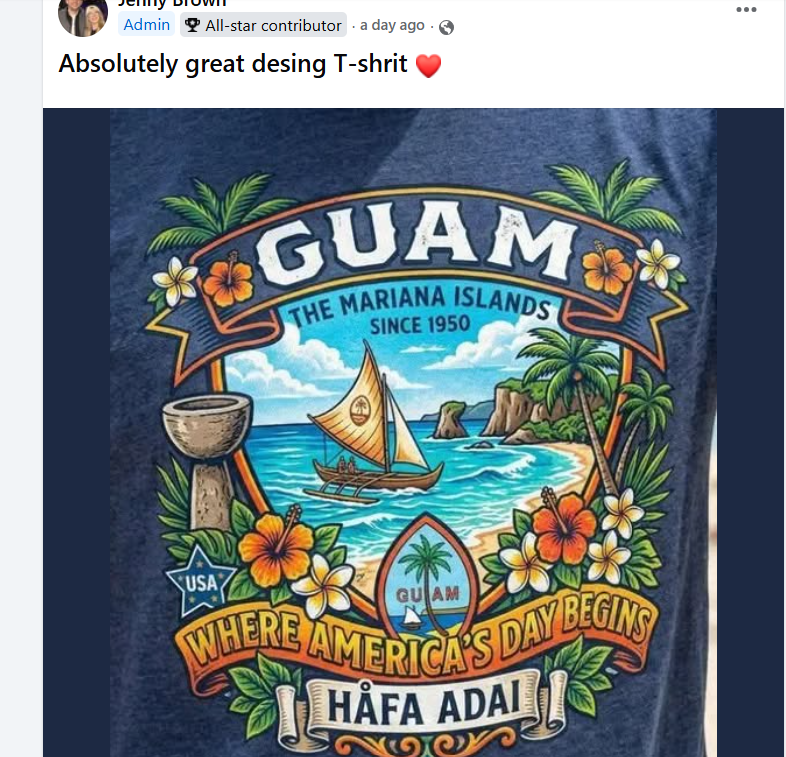
Caption: Jenny Brown, an administrator of LIFE on GUAM, posts a Guam-themed T-shirt.
In the comments, Jenny added a link:
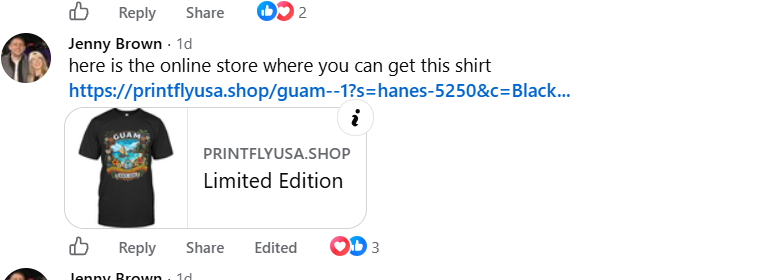
Caption: Jenny Brown directs members to PrintflyUSA.shop to purchase the shirt.
The link led outside Facebook to PrintflyUSA.shop.
Now we had something we hadn’t had before.
A path to a purchase.
A large Facebook community centered around Guam. An administrator promoting Guam-themed merchandise. And a link directing members to an outside storefront.
Does that make it a scam?
No.
Facebook groups promote products every day. Businesses sell T-shirts. Print-on-demand stores can be perfectly legitimate.
But remember what we’ve been doing throughout this investigation:
Don’t stop at the first explanation. Keep looking.
So I did.
Then I found the poster
Another account, Samile Moura, posted a Guam poster in LIFE on GUAM.
The post said:
“Finally this poster is on my wall ❤️”
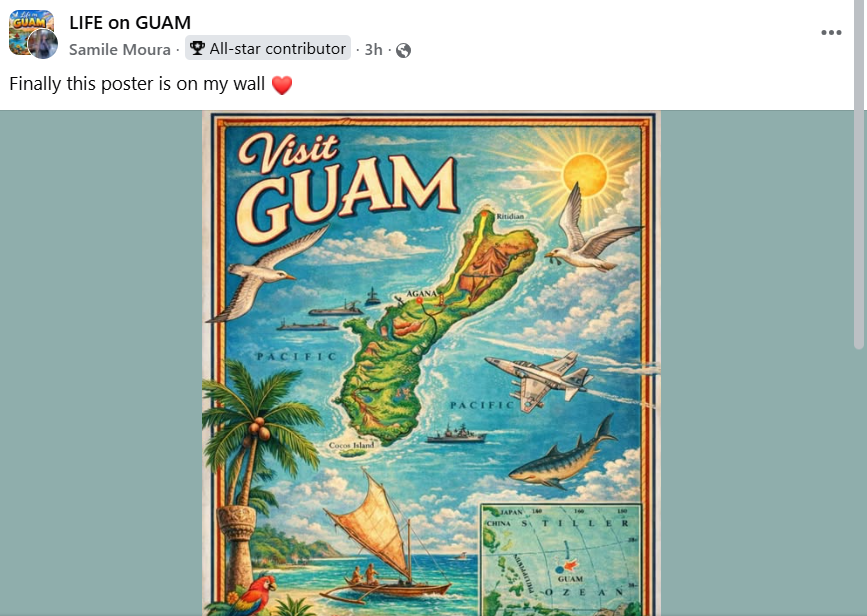
Caption: Samile Moura posts a Guam-themed poster in LIFE on GUAM.
Then, in the comments:
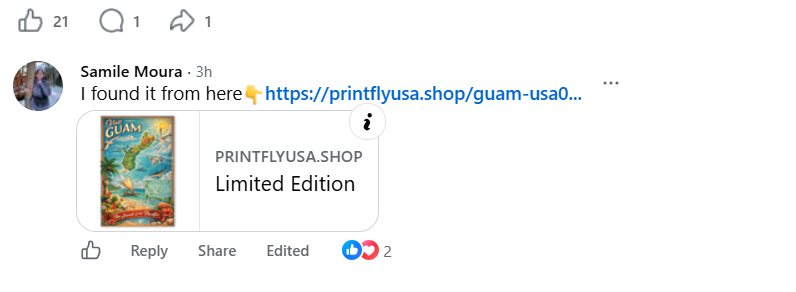
Caption: Samile Moura directs members to PrintflyUSA.shop for the poster.
That link also led to PrintflyUSA.shop.
Now my attention was really piqued.
Two different accounts. Two different Guam-themed products. The same Facebook group. The same outside storefront.
And Samile’s name wasn’t entirely new to me.
Remember that tiny LIFE on FOLORIDA group from Part 1? The one with only 16 members that shared several people with LIFE on GUAM?
Samile Moura was among its members too.
Again, none of that proves fraud.
But it gave me another thread to pull.
And then this investigation got personal.
Wait a minute. That’s MY picture.
As I continued looking through Samile Moura’s Facebook activity, I came across another post.
I knew the photograph immediately.
Because it was mine.
Just a couple of months earlier, I had posted a photo of my mom holding up an old Continental Air Micronesia T-shirt. Not exactly a photographic masterpiece.
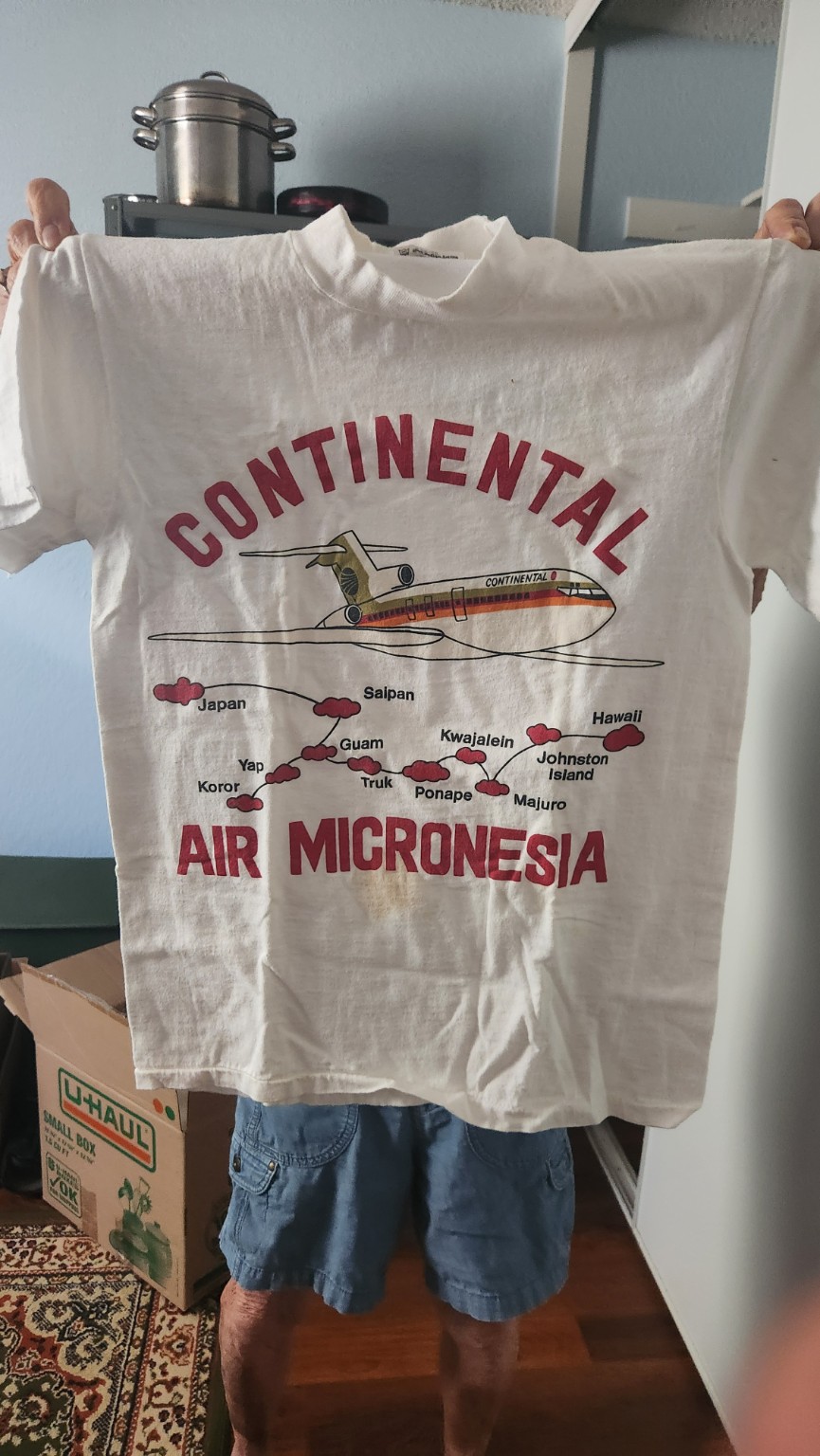
Caption: My original photo of my mom holding up my Continental Air Micronesia T-shirt in her home.
This wasn’t a stock image or a generic product photo pulled from somewhere on the internet.
It was my actual T-shirt, photographed in my mom’s home.
And it’s not exactly a pristine shirt. There’s a very visible stain running down the front of it.
The background is my mom’s home. That’s my mom’s hands holding it. Those are her shorts and legs underneath it. Even the U-Haul box sitting beside her is visible.
Then I found this:
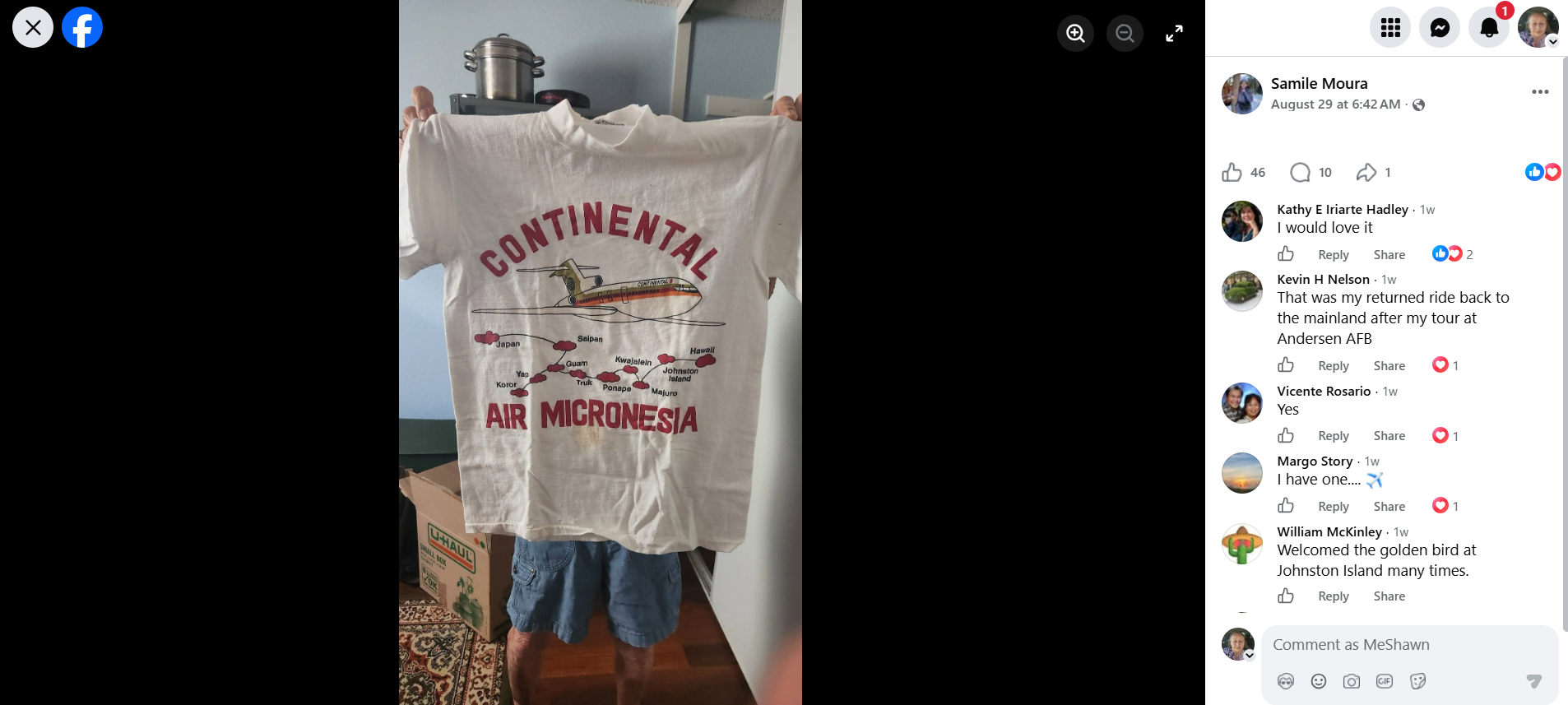
Caption: The same photograph as it appeared in an Aug. 29 Facebook post by Samile Moura. I did not give her permission to use my photo.
That’s my photograph.
I did not give Samile permission to use it.
But then I found something else.
The shirt was for sale.
On PrintflyUSA.shop, I found a newly produced T-shirt featuring what appears to be the same Continental Air Micronesia design shown on the vintage shirt in my photograph.
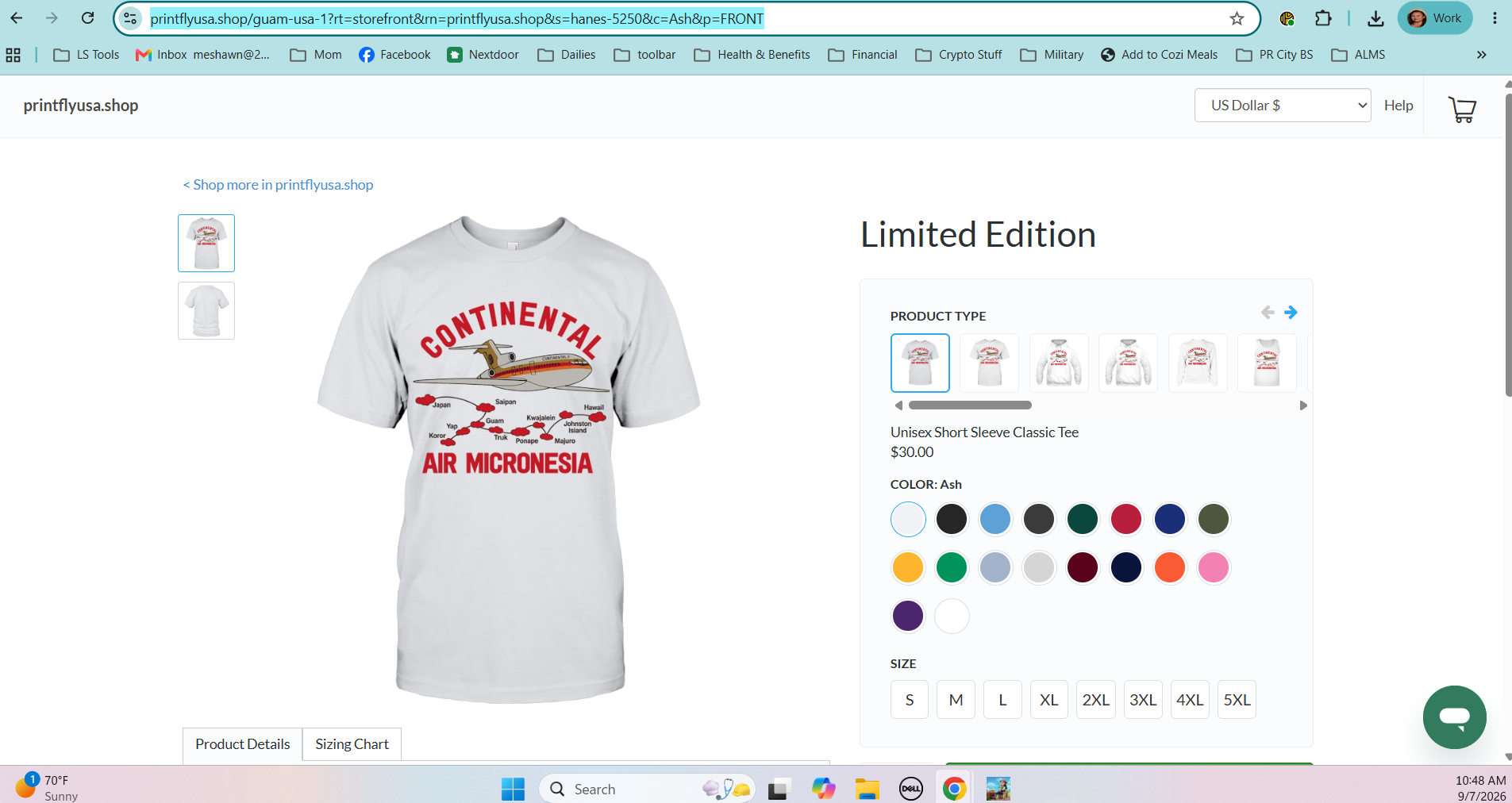
Continental Air Micronesia T-shirt offered for sale on PrintflyUSA.shop. Screenshot captured Sept. 7, 2026.
And remember how I got here.
Samile had already directed LIFE on GUAM members to PrintflyUSA.shop for the Guam poster.
Then I found Samile using my photograph of my vintage Continental Air Micronesia shirt without my permission.
And now I’d found a newly produced version of that shirt being sold on the same storefront.
That’s a pretty remarkable trail.
What I cannot tell you is whether my photograph was used to recreate the design. I don’t have evidence of that. The design could have been obtained somewhere else.
What I can document is the sequence:
My photograph of the vintage shirt → reposted by Samile without my permission → a newly produced shirt featuring what appears to be the same design offered for sale on PrintflyUSA.shop.
And that’s the same PrintflyUSA.shop Samile had already been directing group members to for other Guam merchandise.
Suddenly, finding my photograph in her Facebook activity looked a whole lot more interesting.
And here’s one more interesting development:
Since I commented on the post about my photo being taken and used without my permission, both the post and Samile seem to have disappeared.
I even checked from another Facebook account to make sure I hadn’t simply been blocked.
Make of that what you will.
Remember all those photo requests?
In Part 2, I showed you a post from Jessica Jeli asking LIFE on GUAM members:
“If you have any beautiful photos of Guam that you’ve taken, share them in the comments!”
About 100 comments followed.
At the time, I was very careful about what I said.
I couldn’t tell you why those photographs were being requested. Maybe it was simply engagement. Maybe it was an innocent attempt to get people talking about Guam.
I still can’t tell you what happened to the photographs those members submitted.
And I am not alleging that LIFE on GUAM’s administrators are collecting members’ photographs for commercial use. I don’t have evidence of that.
But I can now tell you something I know firsthand:
A personal photograph I had shared online was taken and reposted without my permission by one of the accounts I encountered during this investigation.
And it happened to be a photograph of merchandise.
That’s no longer a hypothetical lesson for me.
A photo you casually share online can be copied, reposted and used in a context you never intended.
And in my case, the person using it was someone I’d already encountered while following merchandise links.
So I kept following them.
Where did the merchandise links lead?
Both of the merchandise links I’d found led to PrintflyUSA.shop.
The site is an online storefront, and my research led me to GearLaunch, a print-on-demand platform used to create and sell customized merchandise.
That distinction matters.
GearLaunch provides technology and fulfillment services to third-party sellers. Finding GearLaunch behind a storefront does not tell us who operates that particular store.
And that led me to one of my favorite lessons from this entire investigation.
Because for a minute, I thought I’d found something big.
The clue that wasn’t
As I researched other online merchandise stores, I noticed the same phone number appearing more than once:
855-999-7840
Same phone number. Different storefronts.
Well, now…
That looked interesting.
So I checked it.
And guess what?
It belongs to GearLaunch.
In other words, the matching phone number wasn’t evidence that I’d found one person operating multiple stores.
It was shared infrastructure.
Scratch that theory.
And I’m including this because this is what investigating is supposed to look like.
You don’t collect only the facts that support what you already believe.
You follow the evidence.
Sometimes a clue makes your case stronger.
Sometimes it blows up your theory.
Both are useful.
But the research uncovered something else
While researching these kinds of print-on-demand storefronts, I found several reports in the Better Business Bureau’s Scam Tracker involving other stores.
Important distinction:
These are reports submitted by consumers, not BBB findings that a scam or crime actually occurred.
I also found no evidence establishing that the people behind those reported stores are the people behind PrintflyUSA.shop.
What interested me were the behaviors people described.
An April 2026 report alleges that a fake Facebook profile promoted a custom school-reunion T-shirt and that the purchased shirt never arrived.
A July 2026 report alleges that rescue organizations’ logos were being used without permission.
A 2024 report alleges that followers of a nonprofit’s Facebook page were targeted with unauthorized T-shirts that appeared to be associated with the organization.
Another report alleges that an artist’s work was taken and used without permission.
And one 2024 report describes alleged fake Facebook accounts and groups being used to market affinity-based T-shirts.
Again:
Those reports do not prove anything about LIFE on GUAM or PrintflyUSA.shop.
What they do show is that other consumers have reported similar scenarios.
Community identity can be valuable.
So can nostalgia.
So can trust.
And so can the photographs and artwork people put online.
GearLaunch itself advises sellers that they need appropriate rights to photographs and other intellectual property used commercially.
Which brings me right back to that Continental Air Micronesia shirt.
Nobody asked me for permission to use my photograph.
Why follow the money?
Because this isn’t just about weird Facebook accounts anymore.
There is a commercial transaction at the end of at least some of these posts.
And the Federal Trade Commission’s numbers explain why that’s worth paying attention to.
According to FTC data released in April 2026, consumers reported losing $2.1 billion to scams that began on social media in 2025, about eight times the amount reported in 2020.
Shopping scams were the most frequently reported type of social-media scam.
More than 40% of people who reported losing money to a scam that began on social media said it started when they ordered something they’d seen advertised.
And the FTC reported that more money was lost to scams beginning on Facebook than on any other social-media platform.
None of that means the T-shirt you’re seeing in your neighborhood, military, alumni or hometown Facebook group is fraudulent.
It means this:
“I saw it in a Facebook group I trust” is not due diligence.
Before you buy
When someone promotes merchandise inside a Facebook group, particularly one built around a shared hometown, military service, school, heritage or other community connection, look beyond the product.
Who posted it?
Is that person an administrator?
How old is the profile?
What else does the account post?
Where does the link actually take you?
Can you independently identify the business behind the store?
What do you find when you search the domain rather than clicking through Facebook?
And if another member pops up saying how much they love the product, don’t automatically assume you’re looking at an independent customer endorsement.
Look sideways.
Because one of the biggest lessons I’ve taken from this investigation is that trust can be manufactured.
A familiar place name creates trust.
Nostalgia creates trust.
Photos of places you recognize create trust.
Thousands of group members create trust.
Comments from people who seem to share your connection create trust.
But none of those things tells you who is actually on the other side of that Buy button.
One question remained
By this point, I’d followed the administrators.
I’d followed the engagement.
I’d followed the merchandise.
I’d even found my own photograph along the way.
But I still didn’t know how much of what I was seeing was connected.
Was this simply a handful of odd Facebook accounts and merchandise posts?
Or was I looking at something much bigger?
So I went back to the lesson that started this whole investigation.
Don’t just look down. Look sideways.
And that’s where we’ll finish this investigation in Part 4.
Want to see what I found? Subscribe so you don’t miss the final installment.
The Anatomy of a Suspected Facebook Group Scam
This is Part 3 of a four-part investigation.
Part 1: Who’s Running the Show?
Part 2: Engagement Is the Bait
Part 3: Follow the Money (You are here)
Part 4: Coming soon
A note about this investigation: This series documents publicly visible Facebook activity and other publicly available information I found while investigating these groups and related activity. I’ll distinguish between what I can verify, what raises questions, and what is simply my opinion or a theory worth exploring. A red flag is not proof of wrongdoing, and inclusion in this series should not be interpreted as an allegation that any individual or business has committed a crime or engaged in fraud.
If this series helps one more person stop, look and investigate before clicking a link, handing over information or spending money, it’s worth sharing.
And if you know someone who buys things they discover in Facebook groups, send them this one.
Knowledge is power. Pass it on.


 MeShawn Dimos
Leave a comment